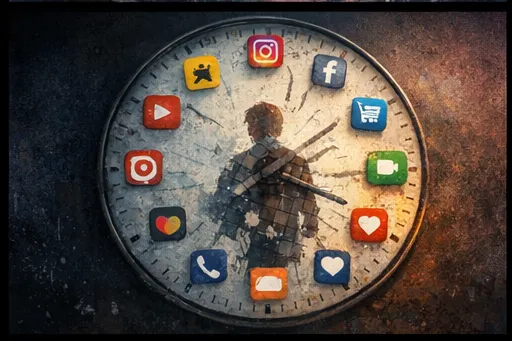
Your Time Isn’t Yours: The Lie of Attention as Choice
It started with a single glance to a flicker in my visual field. The screen came alive. The call of dopamine.
I checked one message. A quick glance. Something pinged. A link. A thread.
Then a reel. Then a scroll. Then a scroll inside the scroll.
And when I came up for air, 42 minutes had evaporated.
Not spent. Not enjoyed. Not even regretted.
Just… gone.
This wasn’t a guilty pleasure. It wasn’t rest.
It wasn’t even procrastination.
It was stolen time.
And it wasn’t an accident.
We Think We’re Choosing. We’re Not.
The lie is this: “You’re in control. Just choose better.” (Which is a lot like the lie of “just use more willpower.”)
But most people don’t know what they’re choosing against.
They don’t realize attention is being captured, not offered.
They don’t realize time is being taken, not traded.
Because it doesn’t feel like theft.
It feels like... habits. Entertainment. Culture. Normal life.
Which is exactly the point.
Systems that want your attention don’t ask for permission.
They design for extraction.
And the more invisible it feels, the more effective it is.
This is the idea behind Marshall McLuhan’s famous observation that “the medium is the message.” That each medium or technology has embedded within it a design that shapes what it can convey, a world-view if you will. For example, television or a video clip is better for communicating about a fire than a newspaper, and a newspaper is better for communicating about economic policy. Expediency is traded for depth, and these biases are invisible.
Attention Is Not a Productivity Tool. It’s Your Life.
We often treat attention like a skill to optimize.
Focus more. Be productive. Set timers. Use hacks.
But attention isn’t a tool.
It’s your life force.
Where your attention goes, your mind goes.
Where your mind goes, your time follows.
And where your time goes, your life becomes.
That’s why this isn’t a conversation about distraction.
It’s a conversation about domination.
When a system captures your attention, it hijacks your choices.
And when it hijacks your choices, it alters your identity.
You don’t become who you want to be.
You become what you’ve been fed.
Kinda harsh.
But the reality is this: media don’t tell us what to think, they shape what we think about. And what we think about we become. At the end of the day, we are a collage of a thousand different snippets, scant few of which expand or deepen our innate sense of our spiritual nature and divinity.
The Myth of Harmless Scrolling
Let’s be honest.
We’ve all told ourselves, “I just need to decompress.”
We open the app. Scroll a little.
Get a hit of novelty.
Laugh. Cry. Gasp. Swipe.
Forget why we opened it in the first place.
20 minutes vanish. 40. Sometimes more.
The data is clear: this is by design.
Social media, entertainment platforms, and even news sites are engineered to exploit the dopamine system — the part of the brain wired to chase novelty, reward, and stimulation.
Every notification, every infinite scroll, every autoplay?
That’s not a tech feature.
That’s behavioral architecture — optimized over years to keep your attention just long enough to monetize it.
And while your attention is pulled, your perception is shaped.
What you value. What you fear. What you believe.
All subtly rewired, scroll by scroll.
Each time you watch a cute animal video, it reinforces both in the algorithm and in your brain that you like cute animal videos. Your brain automatically seeks them and the algorithm automatically feeds them to you.
“But I Like It.” Yes. That’s the Point. Just Like Donuts.
Maybe you’re thinking, But I enjoy social media. I choose it.
Let’s pause there.
Pleasure isn’t the same as freedom.
You can enjoy things that were designed to bypass your conscious will.
That’s how addiction works. That’s how slot machines work. That’s how cookies work.
That’s how attention capture works.
When you say yes to a system that was engineered to override your internal brakes, your yes isn’t fully yours.
And when that system also delivers your news, your community, your culture —
You’re not just being entertained.
You’re being shaped.
The Real Cost: Thought, Presence, and Desire
The cost of attention theft isn’t just time.
It’s thought — the ability to pause, reason, reflect.
It’s presence — with others, with yourself, with reality.
And most invisibly: it’s desire.
When your attention is constantly directed outward, desire shrinks to whatever is offered.
Your deepest longings? Replaced by what’s trending.
Your sense of time? Fragmented into dopamine loops.
Your hunger for meaning? Fed curated lives you can never replicate.
Stolen time isn’t just about distraction.
It’s about disorientation.
And disoriented people don’t rebel.
They comply.
They consume.
Is This Just About Phones?
No.
Phones are just the portal.
The real system is much bigger.
Every time you’re nudged to keep watching,
Keep scrolling,
Keep “engaging” —
You’re being kept from noticing something else:
The conversation you didn’t start.
The idea you didn’t follow through.
The project you didn’t finish.
The silence you didn’t allow.
The truth you didn’t hear.
It’s not the phone.
It’s the system that profits when you’re not fully here.
“But I Need to Be Informed.”
This is where it gets tricky.
We’re told attention is a civic duty.
That consuming content is “staying informed.”
But here’s the truth:
Most modern media doesn’t inform. It occupies.
It floods you with other people’s images, opinions, and scripts.
It replaces your inner voice with curated reactions.
And when you’re full of reaction, there’s no room for reflection.
The result?
You’re exhausted. Anxious. Angry. Scattered.
But you feel informed.
And that feeling keeps you in the loop.
It’s not a bug.
It’s the system functioning perfectly.
What Happens When You Reclaim Your Time?
Something radical.
You start hearing your own thoughts again.
You start noticing what you actually long for.
You remember what it feels like to be grounded. Present. Undistracted.
And then?
You see the theft clearly.
You realize what was taken.
And more importantly, you realize what you can take back.
The Challenge of Omnipresence
Of course, the challenge here is separating ourselves from the tribe: if we are not doing what everyone else is doing, we are separate from, and therefore, from an evolutionary biology standpoint, at risk for survival. Inherent in the choice not to partake is a rejection of the cultural norm, which would make us outsiders. Different. Isolated.
The same is true for choosing not to partake in the culture that glorifies sugar or alcohol. We are seen as outsiders
Being in the world, but not part of it, becomes the existential goal if we want to maintain our sovereignty.
A Gentle Experiment: Try This
For one day:
Count how many times you reach for your phone without needing it. (Seeing the habit.)
Pause before opening any app — ask: “What am I avoiding right now?” (Understanding your nervous system.)
Before bed, write down: Where did my attention go today? (Reflecting is learning.)
Not with judgment. With curiosity.
Because noticing is the first act of liberation.
Final Thought: Your Attention Is Sacred
You don’t have to earn your freedom by being more focused.
You don’t need better hacks or habits.
What you need is truth:
Your attention is not a resource.
It is a right.
And the systems designed to take it from you
aren’t offering convenience.
They’re demanding compliance.
Reclaiming your time and attention is the basis of reclaiming and directing your life.
And no system built on stealing your attention deserves your sacred presence.
Not anymore.